
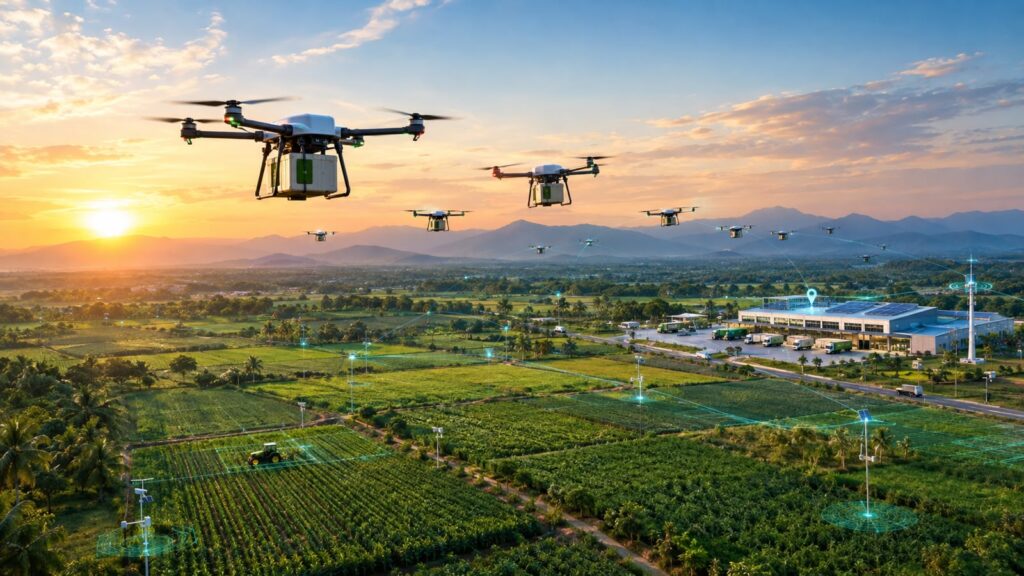
Agriculture is entering a new era where technology is no longer limited to monitoring crops or automating individual tasks. The next major transformation could come from autonomous drone swarms capable of moving agricultural materials, supplies, and harvested produce efficiently across farms.
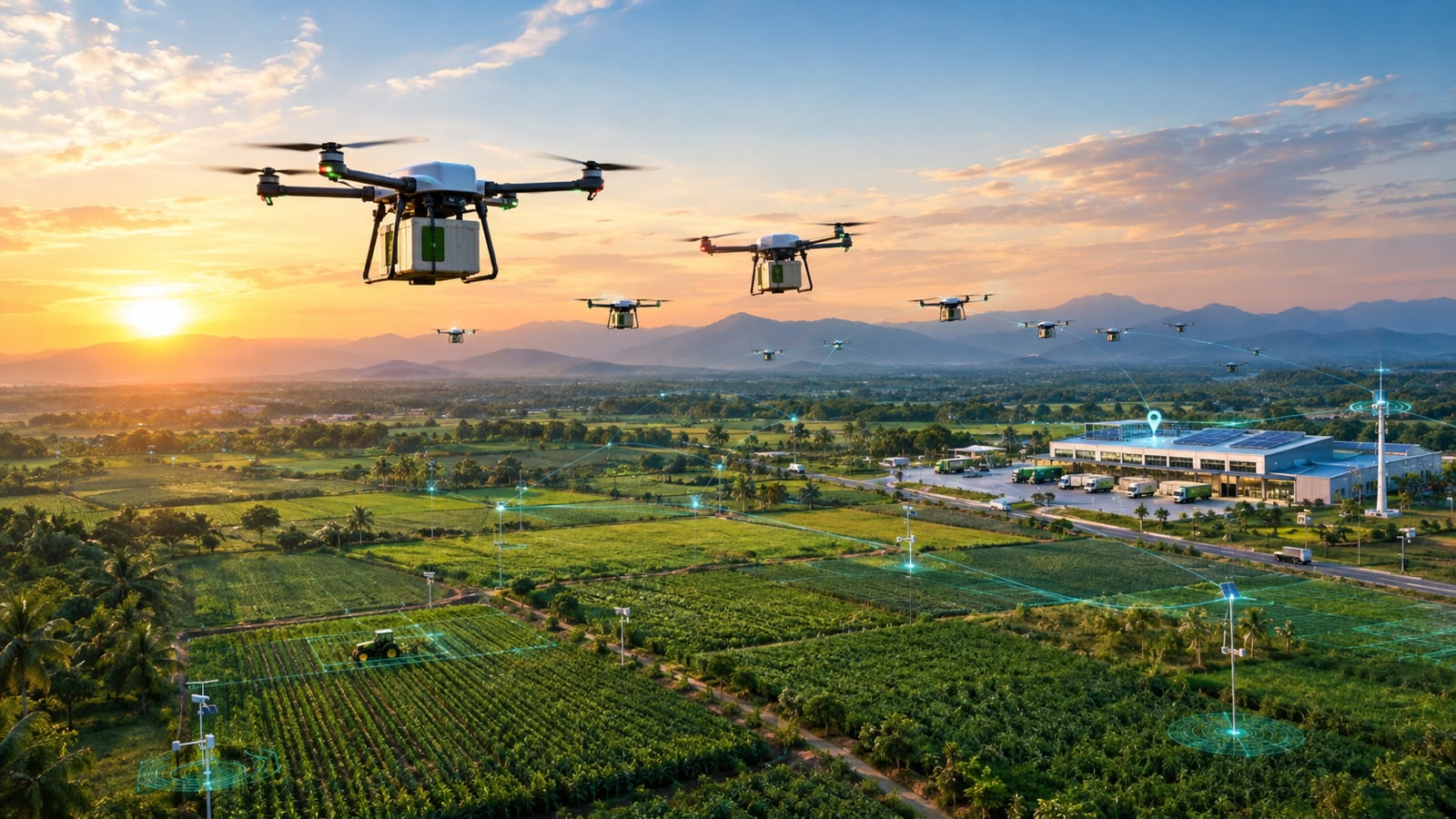
While agricultural drones are already being used for crop monitoring, spraying, mapping, and precision farming, the emergence of swarm logistics drones introduces a much larger possibility: creating an intelligent aerial logistics network for agriculture.
What Are Swarm Logistics Drones?
A drone swarm is a group of autonomous drones that can coordinate with one another to complete tasks collectively.
Instead of relying on a single large drone to transport materials, multiple drones can operate as a coordinated system. They can dynamically divide tasks, select routes, avoid obstacles, communicate with each other, and adapt to changing conditions.
In agriculture, this could mean a fleet of drones transporting:
- Seeds and fertilizers
- Crop protection products
- Irrigation-related supplies
- Tools and spare parts
- Freshly harvested crops
- Farm-to-collection-centre shipments
The objective is not simply to make drones fly faster. It is to create a smarter, flexible, and responsive logistics layer for agricultural operations.
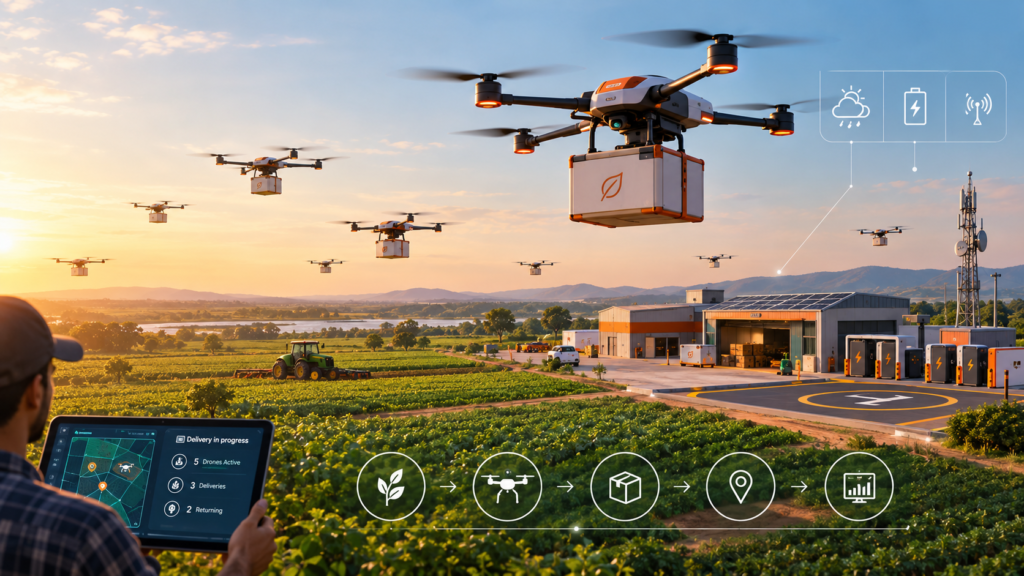
Why Agriculture Needs Smarter Logistics
Agricultural logistics often involves moving materials between farms, storage areas, processing centres, warehouses, and markets.
Many farms are located in areas where conventional transportation can be challenging. Poor roads, long distances, difficult terrain, traffic, and time-sensitive produce can all affect the efficiency of agricultural supply chains.
This is particularly important for perishable products.
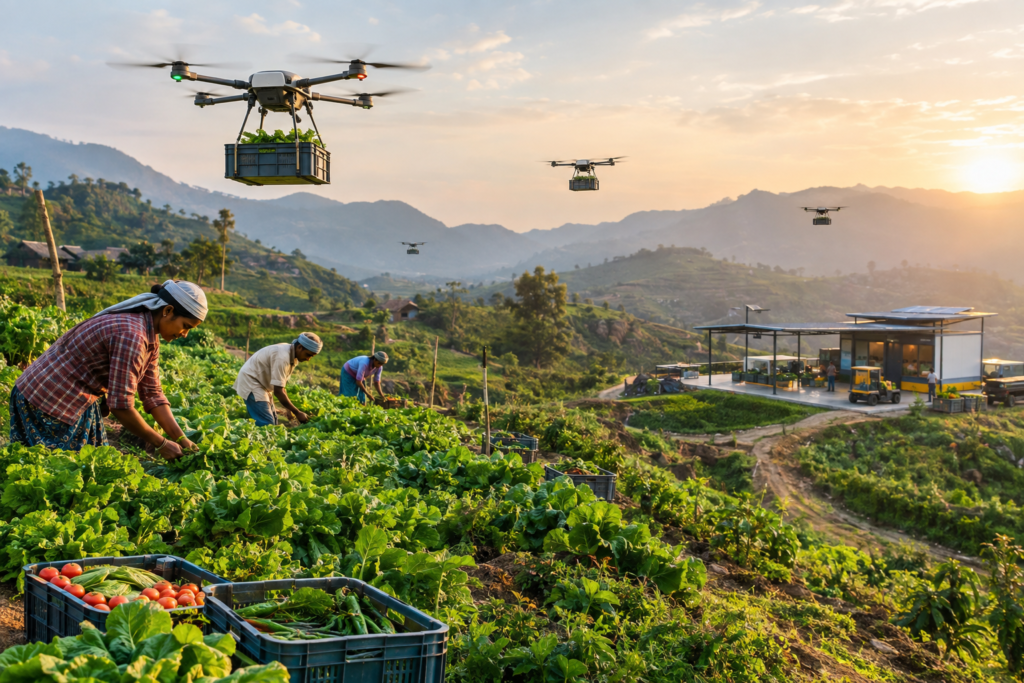
For example, imagine a farm harvesting fresh vegetables in the morning. Instead of waiting for a vehicle to arrive, an autonomous drone fleet could potentially collect smaller batches from different points and transport them to a nearby collection centre.
This could help reduce delays between harvesting and aggregation.
From Single Drones to Coordinated Fleets
The real potential lies in moving from individual drone operations to coordinated fleets.
A single drone has limitations in terms of payload, range, battery capacity, and operating time. A swarm can potentially distribute the workload among multiple aircraft.
For example:
Farm → Drone Fleet → Collection Centre → Processing Facility
One drone could transport a small load while another returns for charging or battery replacement. Meanwhile, other drones could continue serving different parts of the farm.
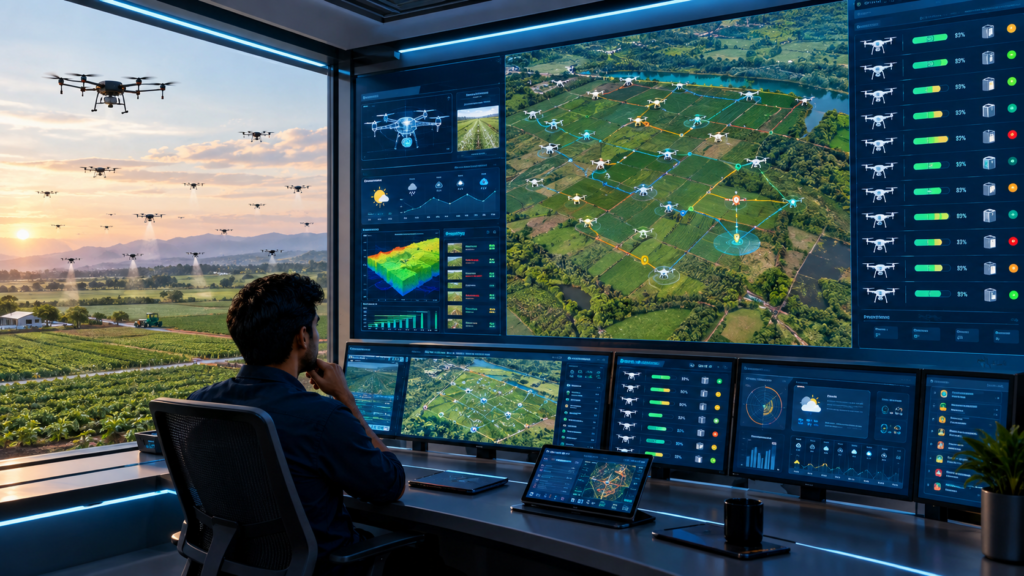
An intelligent fleet-management system could continuously assign tasks based on:
- Distance
- Payload
- Battery level
- Weather conditions
- Delivery priority
- Drone availability
- Farm location
This creates a logistics system that can respond dynamically rather than following a fixed transportation schedule.
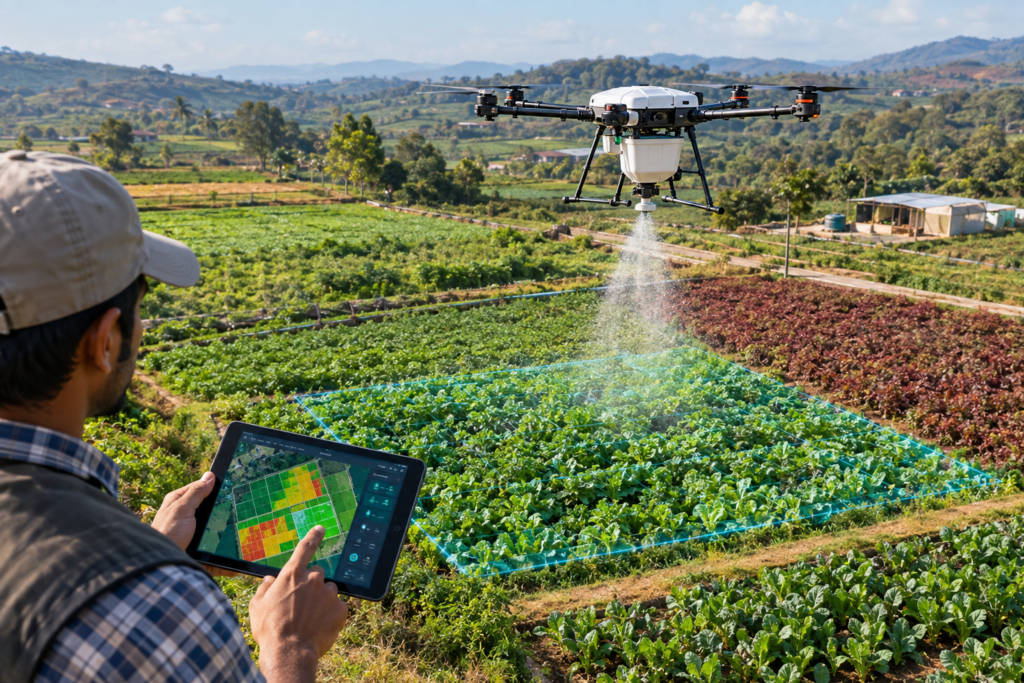
Precision Logistics: Delivering What Is Needed, Where It Is Needed
Precision agriculture focuses on giving crops the right resources at the right time and in the right quantity.
Swarm logistics could extend this principle beyond crop monitoring and treatment into material movement.
Instead of transporting large quantities of fertilizer or other agricultural inputs to an entire farm, drones could potentially deliver smaller quantities to specific locations based on field requirements.
Combined with data from sensors, satellites, agricultural software, and farm-management platforms, drone fleets could become part of an integrated decision-making system.
For example:
Crop data → Requirement identified → Task automatically created → Drone assigned → Material delivered
This could reduce unnecessary movement and improve resource utilization.
Faster Movement of Fresh Produce
One of the most promising applications is the transportation of harvested produce.
Fresh agricultural products are highly time-sensitive. Every additional delay between harvesting and cooling, storage, processing, or distribution can affect quality.
Swarm logistics drones could support short-distance transportation between difficult-to-access farm locations and nearby collection or processing points.
Rather than replacing conventional trucks entirely, drones could complement them.
A possible future logistics model could look like:
Farm → Drone → Local Collection Hub → Truck → Regional Distribution Centre
Here, drones handle the first-mile or difficult-to-reach segment, while conventional transportation handles larger-volume long-distance movement.
Supporting Farmers in Remote Areas
Remote farms often face logistical challenges that are different from those of farms located close to major roads.
Aerial logistics could provide an additional transportation option for locations where road access is limited or inefficient.
During certain situations—such as seasonal flooding, damaged roads, or difficult terrain—autonomous drone fleets could potentially provide temporary logistics support.
This could make agricultural supply chains more resilient.
The Role of AI in Drone Swarms
The intelligence behind a drone swarm is just as important as the aircraft themselves.
AI and autonomous fleet-management systems can help drones make decisions based on real-time information.
A future agricultural drone network could continuously evaluate:
- Which drone is closest to the destination
- Which drone has sufficient battery
- Which route is safest
- Which delivery has the highest priority
- Whether weather conditions require rerouting
- When a drone should return for charging
This transforms drones from individual flying machines into coordinated logistics assets.
Integration With Smart Farms
The biggest opportunity comes when drone logistics becomes connected with the broader digital agriculture ecosystem.
Imagine a smart farm where sensors monitor soil conditions, cameras monitor crops, weather systems provide forecasts, and farm-management software tracks inventory.
When the system identifies a requirement, the logistics network could potentially respond automatically.
For example:
Sensor detects low nutrient levels → Farm system generates requirement → Inventory confirms availability → Drone swarm receives delivery task → Drone transports required material → Delivery is recorded digitally.
This creates a connected agricultural ecosystem where information and physical resources move together.
Challenges That Must Be Solved
Despite the potential, swarm logistics in agriculture is not without challenges.
- Battery and Payload Limitations
Drone endurance and payload capacity remain important constraints. Improvements in battery technology, lightweight materials, and alternative energy systems will be essential.
- Weather Conditions
Agricultural environments are exposed to wind, rain, heat, and changing weather. Autonomous systems must be capable of operating safely within defined environmental limits.
- Airspace Management
Large-scale drone operations will require effective coordination with aviation authorities and other airspace users.
- Safety and Reliability
When multiple autonomous drones operate simultaneously, collision avoidance, communication reliability, emergency procedures, and fail-safe mechanisms become critical.
- Infrastructure
Drone logistics requires supporting infrastructure such as charging stations, landing zones, communication networks, and collection hubs.
- Economics
For widespread adoption, drone logistics must provide a clear economic advantage compared with existing transportation methods.
The future will therefore depend not only on better drones, but also on better infrastructure, regulations, software, and business models.
What Could the Future Look Like?
The agricultural supply chain of the future could become increasingly automated.
A farmer may not need to manually coordinate every movement of agricultural materials. Instead, a digital platform could monitor farm requirements and coordinate autonomous drones accordingly.
A typical future workflow could be:
Detect → Decide → Dispatch → Deliver → Monitor
This could create a more responsive agricultural supply chain where transportation happens based on real-time requirements rather than fixed schedules.
In the longer term, drone fleets could work alongside autonomous ground vehicles, warehouses, robotic harvesting systems, and AI-powered farm-management platforms.
The result would be a connected logistics ecosystem spanning the entire agricultural value chain.
Conclusion
Swarm logistics drones have the potential to take agricultural drone technology beyond seeing and treating crops toward moving the resources that agriculture depends on.
The future of agricultural logistics may not be about replacing trucks or traditional transportation completely. Instead, it could involve combining different modes of transportation and allowing each to perform the task it is best suited for.
Drones could handle time-sensitive, lightweight, short-distance, and difficult-to-access movements, while conventional logistics continues to manage high-volume transportation.
As AI, autonomous navigation, battery technology, connectivity, and drone infrastructure continue to advance, swarm logistics could become an important component of the next generation of smart agriculture.
The farm of the future may not just be connected—it may be continuously moving, adapting, and responding through an intelligent network of autonomous machines.