
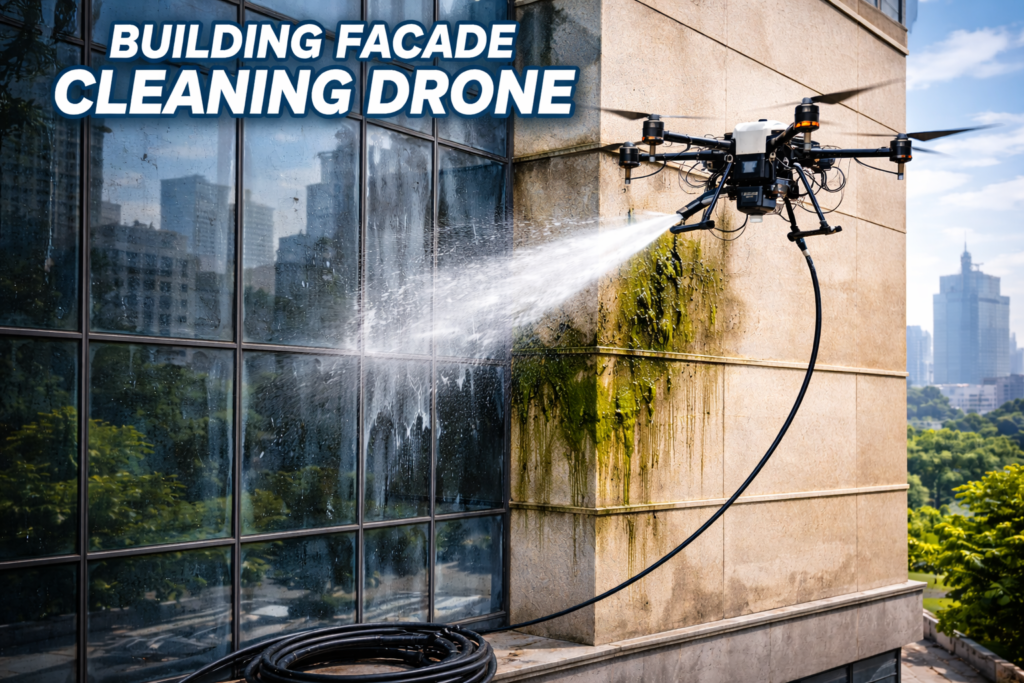
BUILDING FACADE CLEANING: TRADITIONAL METHODS VS DRONE TECHNOLOGY
Keeping a building’s exterior clean is more than just aesthetics — it directly impacts structural durability, brand image, safety compliance, and long-term maintenance costs. With rapid advancements in drone technology, building facade cleaning is undergoing a major transformation.
WHAT IS BUILDING FACADE CLEANING?
Building facade cleaning is the process of removing dirt, dust, pollution, stains, algae, Mold, bird droppings, and other contaminants from the exterior surface (facade) of a building. The facade is the outer face of a structure — including glass panels, concrete walls, metal cladding, stone finishes, and architectural elements.
Over time, environmental factors such as:
- Air pollution
- Rain and hard water deposits
- Industrial emissions
- Coastal salt exposure
- UV radiation
can cause discoloration, corrosion, and structural deterioration.
COMMON TRADITIONAL METHODS OF FACADE CLEANING
Before the rise of automation and drone technology, facade cleaning relied heavily on manual and mechanical access systems. These traditional facade cleaning methods are still widely used in residential, commercial, and high-rise buildings.
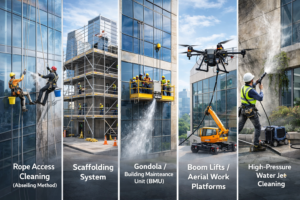
Here are the most common approaches:
- Rope Access Cleaning (Abseiling Method) – This method involves trained technicians suspended from the rooftop using ropes, harnesses, and safety gear to manually clean building exteriors.
- Scaffolding System – Scaffolding System is a traditional method used in building facade cleaning where a temporary metal structure is erected around a building to provide workers safe access to exterior surfaces. High installation and maintenance cost also Limited manoeuvrability on irregular structures.
- Gondola / Building Maintenance Unit (BMU) – A gondola system (also known as a Building Maintenance Unit) is a mechanical platform installed on the rooftop that moves vertically along the facade. Limited height reaches and requires large ground space
- Boom Lifts / Aerial Work Platforms – Hydraulic lifting machines (cherry pickers or boom lifts) are used to elevate workers to access building exteriors.
- High-Pressure Water Jet Cleaning – Water jet systems are used to remove tough stains, dust, and pollutants from facade surfaces. But can damage delicate surfaces.
CHALLENGES OF TRADITIONAL FACADE CLEANING METHODS
While effective, traditional methods commonly face:
- Worker safety risks at height
- High insurance and labour costs
- Longer project timelines
- Operational disruption
- Limited access to complex architectural designs
DRONE-BASED BUILDING FACADE CLEANING
Drone-based building facade cleaning is a modern method of exterior maintenance that uses industrial drones equipped with high-pressure spraying systems and real-time cameras to clean building surfaces safely and efficiently.
Instead of suspending workers at heights using ropes or scaffolding, drones perform the cleaning operation from the air, controlled by trained operators from the ground.
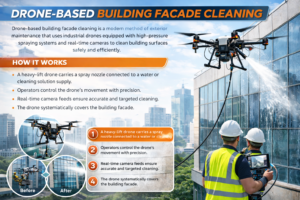
HOW IT WORKS
- A heavy-lift drone carries a spray nozzle connected to a water or cleaning solution supply.
- Operators control the drone’s movement with precision.
- Real-time camera feeds ensure accurate and targeted cleaning.
- The drone systematically covers the building facade.
KEY BENEFITS
- Improved Safety – Eliminates human exposure to height-related risks.
- Faster Execution – Reduces project timelines significantly.
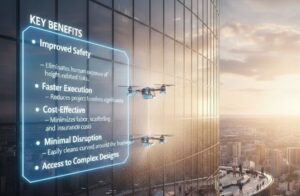
- Cost-Effective – Minimizes labor, scaffolding, and insurance costs.
- Minimal Disruption – No bulky installations around the building.
- Access to Complex Designs – Easily cleans curved or irregular structures.
WHY EFFICIENCY MATTERS IN COMMERCIAL BUILDINGS
Efficiency in commercial building maintenance — especially in services like facade cleaning — directly impacts cost, safety, tenant satisfaction, and long-term asset value.
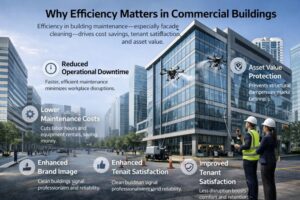
- Reduced Operational Downtime – Commercial buildings house offices, retail stores, hospitals, and IT parks. Faster and more efficient maintenance minimizes disruption to daily operations and business continuity.
- Lower Maintenance Costs – Efficient processes reduce labour hours, equipment rentals, and setup time — leading to measurable cost savings over time.
- Enhanced Brand Image – A well-maintained and clean building reflects professionalism. For commercial properties, appearance directly influences clients, investors, and tenants.
- Improved Tenant Satisfaction – Minimal noise, obstruction, and disturbance during maintenance increase tenant comfort and retention.
- Asset Value Protection – Regular and efficient upkeep prevents long-term structural damage, preserving the building’s market value.
- Better Safety Management – Efficient systems often reduce human risk exposure, lowering accident rates and insurance liabilities.
TRADITIONAL VS DRONE FACADE CLEANING: DETAILED COMPARISON
Traditional facade cleaning methods such as rope access, scaffolding, and gondola systems rely heavily on manual labour and physical access structures, which often result in longer project timelines, higher setup costs, and increased safety risks. These methods require multiple workers operating at heights, making them more vulnerable to weather conditions, human error, and insurance liabilities. Installation of scaffolding or access equipment can also disrupt daily business operations and require significant ground space.
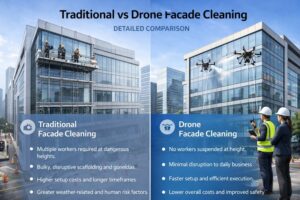
In contrast, drone-based facade cleaning uses industrial UAV systems equipped with high-pressure spray mechanisms and real-time monitoring cameras to clean building exteriors without suspending workers at height. This approach significantly reduces setup time, manpower requirements, and operational risks. Drones can access complex architectural designs and high-rise structures more efficiently while minimizing disruption to occupants and surrounding areas. Overall, drone cleaning offers faster execution, improved safety, cost optimization, and greater flexibility compared to traditional facade cleaning methods, making it a more efficient solution for modern commercial buildings.
Types of Outputs in Drone Facade Cleaning
Drone-based facade cleaning delivers more than just surface washing. Modern systems provide multiple valuable outputs that support maintenance planning, reporting, and asset management.
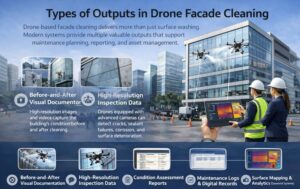
- Before-and-After Visual Documentation – High-resolution images and videos capture the building’s condition before and after cleaning. This helps in quality verification and client reporting.
- High-Resolution Inspection Data – Drones equipped with advanced cameras can detect cracks, sealant failures, corrosion, and surface deterioration during the cleaning process.
- Condition Assessment Reports – Operators can generate structured reports highlighting damaged areas, staining patterns, or structural concerns identified during operation.
- Thermal Imaging (Optional) – If equipped with thermal sensors, drones can detect moisture intrusion, heat leakage, or insulation issues behind facade panels.
- Maintenance Logs & Digital Records – All collected data can be stored digitally for compliance documentation, insurance purposes, and future maintenance planning.
- Surface Mapping & Analytics (Advanced Systems) – Some advanced drone systems integrate AI-based analysis to classify stains, measure surface coverage, and optimize cleaning efficiency.
SAFETY IMPROVEMENTS WITH DRONE TECHNOLOGY
Drone technology has significantly improved safety standards in building facade cleaning by removing the need for workers to operate at dangerous heights. Traditional methods such as rope access and scaffolding expose workers to fall risks, equipment failure, and weather-related hazards. Drone-based cleaning eliminates direct human suspension, drastically reducing the likelihood of height-related accidents.
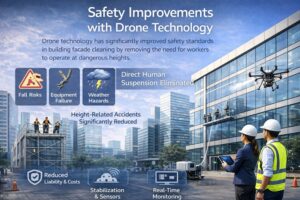
By operating drones from the ground, companies minimize worker exposure to unstable platforms, rope malfunctions, and fatigue-related errors. This not only lowers accident rates but also reduces insurance premiums and liability risks. Additionally, modern industrial drones are equipped with stabilization systems, obstacle sensors, and real-time monitoring cameras, ensuring controlled and precise operations even in challenging environments.
Overall, drone technology enhances workplace safety, improves compliance with occupational safety regulations, and creates a more secure maintenance process for high-rise and commercial buildings.
CONCLUSION
Building facade cleaning is crucial for maintaining safety, appearance, and long-term structural health. While traditional methods are effective, they involve higher risks, longer timelines, and greater costs. Drone-based facade cleaning offers a faster, safer, and more efficient solution — reducing human risk, minimizing disruption, and improving overall maintenance performance.