
How Logistics Drones Are Transforming Modern Agriculture
Logistics drones are unmanned aerial vehicles designed to transport goods from one location to another. Unlike conventional agricultural drones that primarily focus on spraying or collecting crop data, logistics drones are equipped with payload systems designed specifically for carrying materials.
Depending on their design and payload capacity, these drones can support short-distance transportation within farms as well as longer routes between agricultural facilities.
For example, a logistics drone could transport a bag of seeds from a farm storage area to a remote field, deliver fertilizers to a location that is difficult for tractors to access, or move harvested vegetables from a field to a nearby collection point.
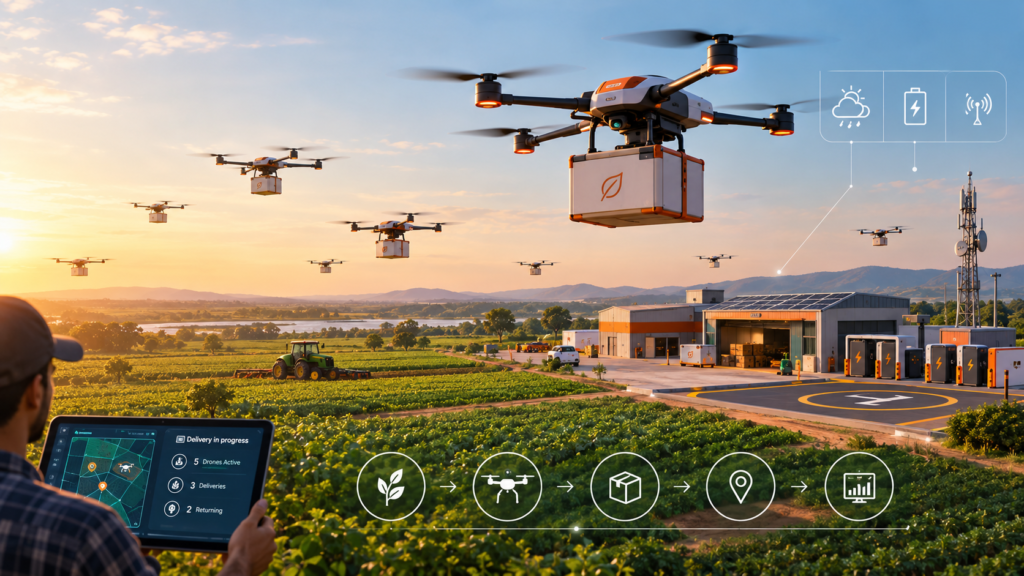
- Transporting Seeds to Remote Fields
One of the most practical applications of logistics drones is the transportation of seeds.
Large farms can have fields spread across considerable distances, while some agricultural areas may be separated by canals, uneven terrain, or poor road connectivity. Transporting small quantities of seeds using tractors or other vehicles can take considerable time.
Logistics drones can carry seed packages directly to designated locations.
Benefits:
- Faster transportation between farm locations
- Reduced manual carrying
- Better access to remote fields
- Reduced dependence on farm vehicles
- Useful for time-sensitive agricultural operations
This becomes particularly valuable during sowing seasons, when farmers need to move large quantities of inputs quickly.
- Fertilizer Transportation
Fertilizers are essential agricultural inputs, but moving them across large farms can require significant manual effort.
Instead of workers carrying fertilizer bags across difficult terrain, logistics drones can transport smaller payloads directly to the required location.
For example, fertilizers can be moved from a storage point to a field section where farm machinery cannot easily reach.
This can help reduce unnecessary movement of workers and agricultural vehicles while improving operational efficiency.
- Delivery of Pesticides and Crop Protection Products
Agricultural operations often require pesticides, biological agents, and other crop protection products to be available at the right place and time.
Logistics drones can transport these materials from a central storage area to specific field locations.
This is particularly useful on large farms where workers may otherwise need to travel long distances simply to move agricultural inputs.
Importantly, transportation and spraying can be treated as two separate drone operations. A logistics drone focuses on moving the material, while a spraying drone or ground equipment can handle application according to applicable safety and regulatory requirements.
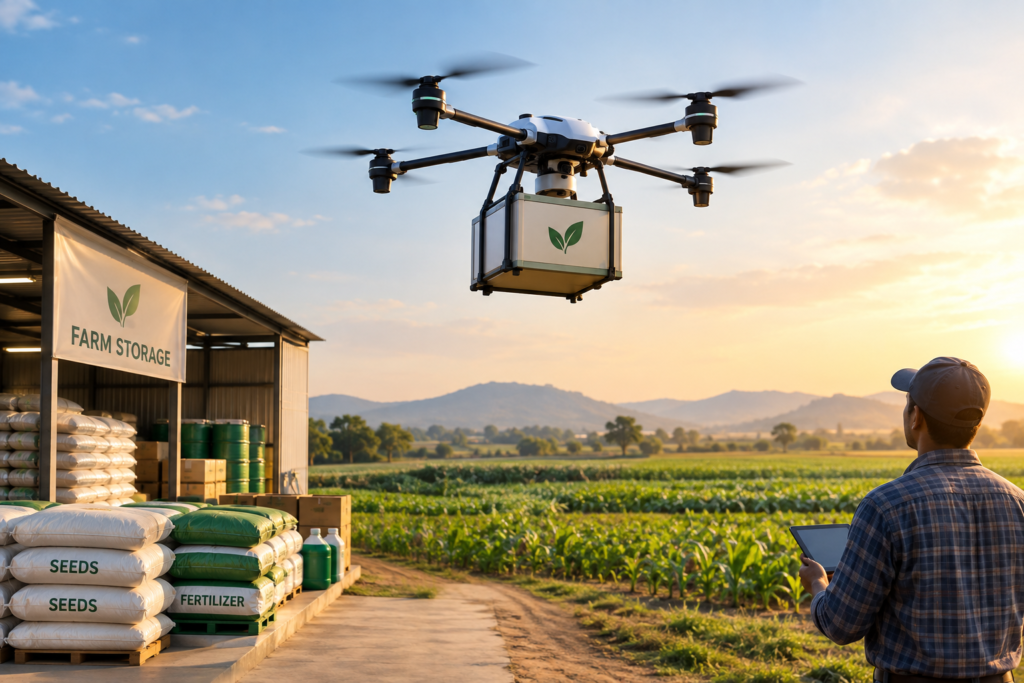
- Moving Tools and Equipment Across Large Farms
Agricultural workers frequently need tools, spare parts, batteries, irrigation components, and other equipment at different locations.
When a required tool is several kilometres away, sending a worker or vehicle to retrieve it can cause unnecessary downtime.
A logistics drone can transport lightweight equipment directly to the worksite.
Example:
A maintenance team working on an irrigation system discovers that a particular component is missing.
Instead of stopping the work and sending a vehicle back to the storage facility, a drone could potentially deliver the component directly to the team.
This can help reduce downtime and improve workforce productivity.
- Harvested Crop Transportation
One of the most interesting applications of logistics drones is post-harvest transportation.
Fresh agricultural products often need to move quickly from the field to collection centres, cold-storage facilities, processing units, or local markets.
Traditional transportation can be slowed by:
- Poor rural roads
- Traffic
- Difficult terrain
- Long distances
- Limited availability of vehicles
Logistics drones can provide an aerial transportation option for selected high-value or time-sensitive agricultural products.
For example, freshly harvested fruits, vegetables, flowers, or other perishable products could potentially be transported from difficult-to-access farms to nearby collection points.
- Transportation in Hilly and Difficult Terrain
Agricultural land is not always located in easily accessible areas.
Farms in hilly regions, plantations, forests, and areas with uneven terrain can present significant transportation challenges.
Conventional vehicles may struggle to reach certain locations, while workers may have to carry materials manually.
Logistics drones can overcome many ground-access limitations because they travel through the air.
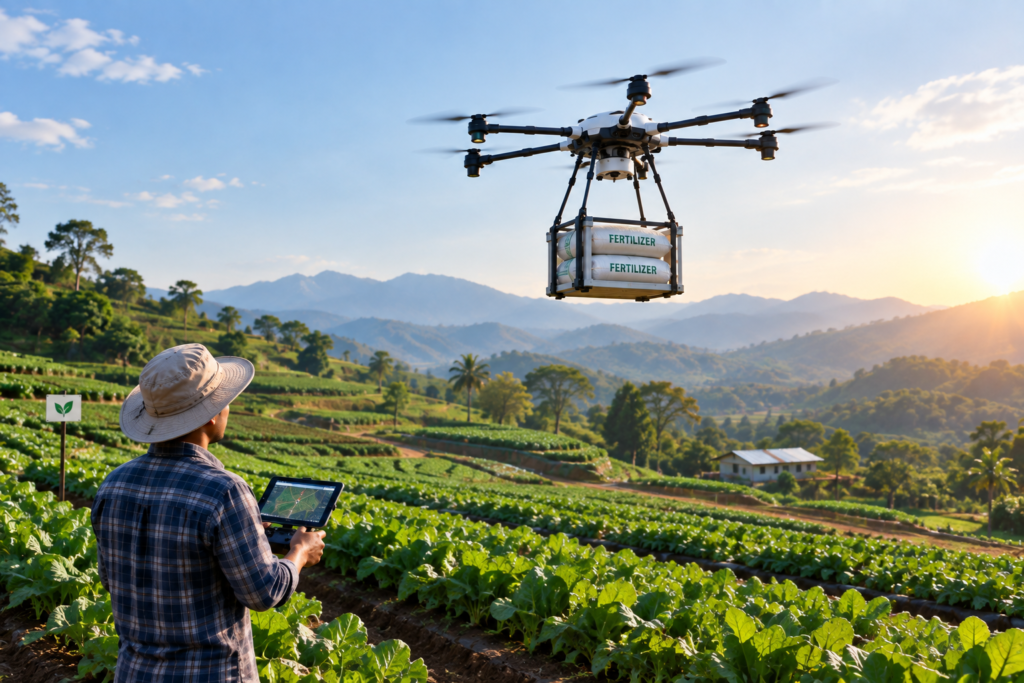
Potential applications include:
- Plantation agriculture
- Hill farming
- Tea and coffee estates
- Remote horticultural farms
- Mountainous agricultural areas
This makes drones particularly valuable where road infrastructure is limited.
- Emergency Delivery of Agricultural Inputs
Agriculture is highly dependent on timing. Delays in receiving essential materials can affect crop operations.
Suppose a farmer urgently needs a particular agricultural input or spare component during an important stage of cultivation. Waiting for conventional transportation may result in operational delays.
A logistics drone can potentially provide rapid point-to-point delivery for small, urgent consignments.
This could be useful for:
- Emergency crop inputs
- Irrigation components
- Equipment spare parts
- Seeds
- Biological products
- Farm tools
The ability to respond quickly can be especially valuable during critical agricultural periods.
- Farm-to-Storage Transportation
After harvesting, crops often need to be moved from the field to a nearby storage or collection facility.
This first stage of transportation is sometimes called the farm-to-storage or farm-to-collection movement.
Drones could support this process by moving smaller quantities from difficult-to-access field locations to centralized collection points.
This could complement—not necessarily replace—traditional vehicles.
For instance:
Field → Drone → Collection Point → Truck → Warehouse
Such a hybrid model could combine the flexibility of drones with the higher capacity of conventional transportation.
- Supporting Cold-Chain Logistics
Certain agricultural products require rapid transportation under controlled conditions.
Examples include:
- Fruits
- Vegetables
- Flowers
- Dairy-related products
- Other temperature-sensitive agricultural goods
While drones may not be suitable for transporting large quantities, they can potentially support last-mile or short-distance movement of high-value and time-sensitive products.
Future logistics drone systems could also integrate insulated or temperature-controlled payload compartments for specific applications.
- Livestock and Dairy Farm Logistics
The use of drones in agriculture can extend beyond crop farming.
Large livestock and dairy farms may have multiple operational areas spread across a large property.
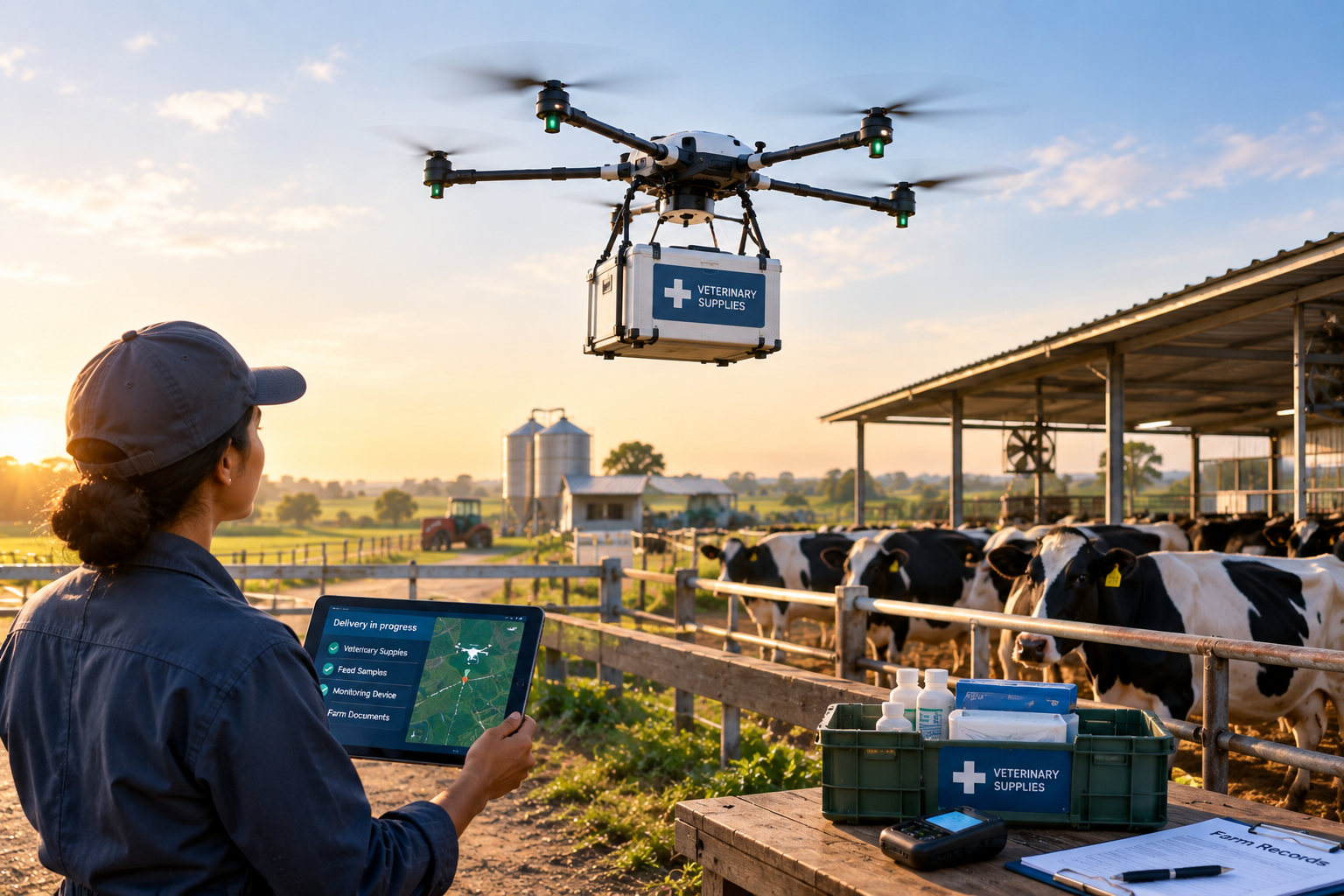
Logistics drones could potentially transport lightweight supplies such as:
- Veterinary supplies
- Small equipment
- Feed samples
- Farm documents
- Monitoring devices
- Maintenance components
This could reduce unnecessary travel across large agricultural properties.
- Supporting Agricultural Warehouses and Distribution Centres
Agricultural logistics does not end at the farm.
Warehouses and distribution centres handle large volumes of agricultural inputs and products. Drones could potentially support internal or short-distance movement of lightweight goods.
For example, drones could be used for:
Warehouse → Loading Area → Collection Point
or
Storage Facility → Nearby Farm
This creates opportunities for integrating drones into broader agricultural supply-chain systems.
- Drone Delivery for Precision Agriculture
Precision agriculture relies on accurate and timely information.
Data from sensors, satellites, IoT devices, and agricultural drones can identify areas requiring specific interventions.
Logistics drones can complement this ecosystem by transporting the required materials to those locations.
For example:
Monitoring Drone → Identifies Problem Area → Data Analysis → Logistics Drone → Delivers Required Input
This creates a more responsive agricultural system where resources can be delivered based on actual field requirements.
Key Advantages of Logistics Drones in Agriculture
The adoption of logistics drones can provide several potential advantages.
⚡ Faster Transportation
Drones can travel directly between locations without being restricted by many ground-level obstacles.
👷 Reduced Manual Effort
Workers do not need to manually carry agricultural inputs across long distances or difficult terrain.
🛣️ Reduced Dependence on Roads
Drones can be particularly useful where roads are poor, congested, or unavailable.
⏱️ Better Time Management
Rapid transportation can help farmers respond more quickly to operational requirements.
🌱 Improved Agricultural Efficiency
Better movement of resources can contribute to more efficient farm operations.
📦 Flexible Last-Mile Delivery
Drones can potentially handle small, urgent deliveries where conventional transportation may be inefficient.
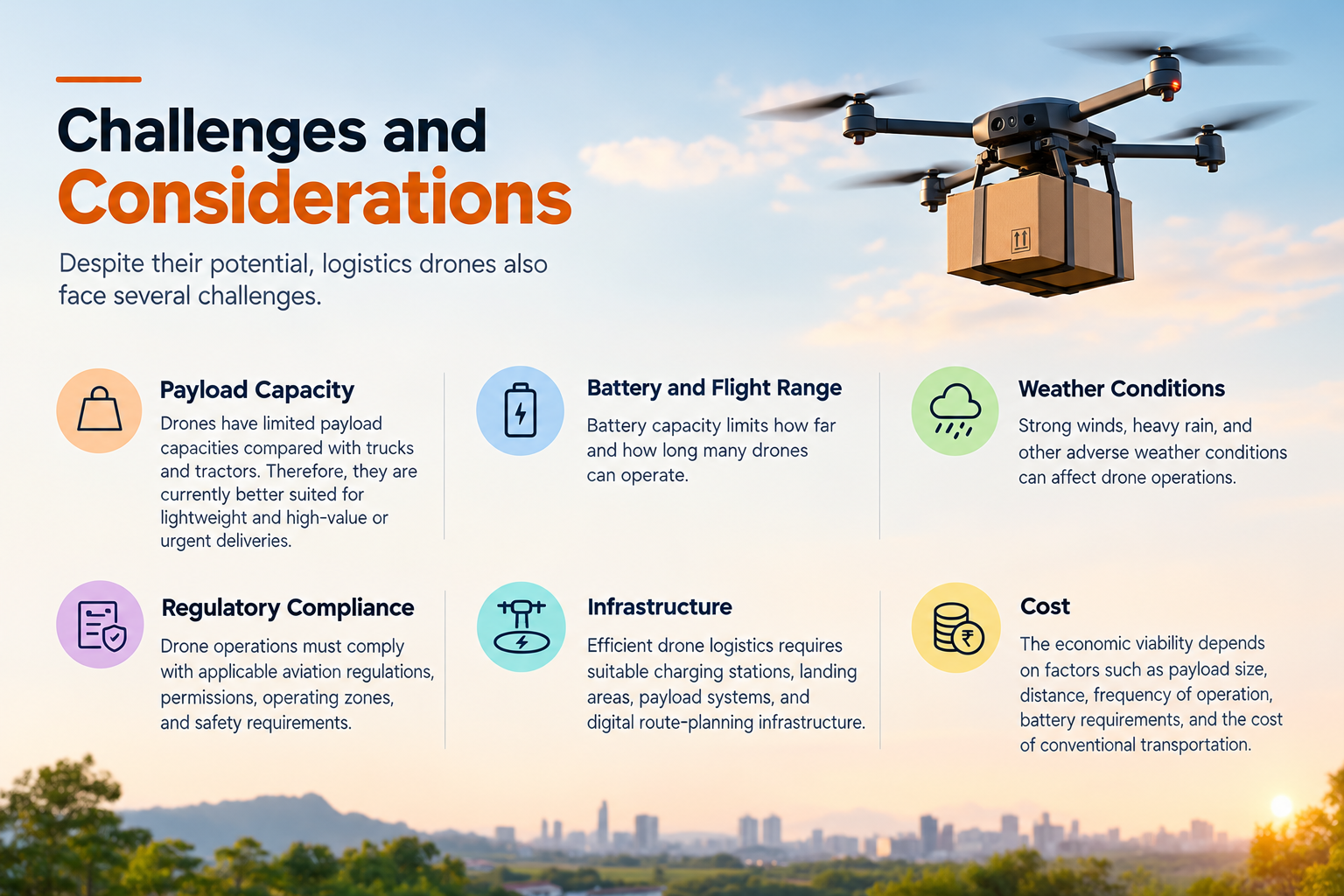
Challenges and Considerations
Despite their potential, logistics drones also face several challenges.
Payload Capacity
Drones have limited payload capacities compared with trucks and tractors. Therefore, they are currently better suited for lightweight and high-value or urgent deliveries.
Battery and Flight Range
Battery capacity limits how far and how long many drones can operate.
Weather Conditions
Strong winds, heavy rain, and other adverse weather conditions can affect drone operations.
Regulatory Compliance
Drone operations must comply with applicable aviation regulations, permissions, operating zones, and safety requirements.
Infrastructure
Efficient drone logistics requires suitable charging stations, landing areas, payload systems, and digital route-planning infrastructure.
Cost
The economic viability depends on factors such as payload size, distance, frequency of operation, battery requirements, and the cost of conventional transportation.
The Future of Agricultural Drone Logistics
The future of agricultural logistics is likely to involve multiple transportation technologies working together rather than drones completely replacing conventional vehicles.
A possible future agricultural supply chain could look like:
Supplier → Warehouse → Truck → Farm Hub → Logistics Drone → Field
At the same time, AI, GPS, IoT sensors, automated charging stations, and fleet-management software can make drone-based logistics increasingly intelligent and automated.
As drone technology develops, improvements in payload capacity, battery technology, autonomous navigation, and fleet coordination could expand their role in agricultural supply chains.
The combination of agriculture + drones + digital logistics has the potential to create faster, more flexible, and data-driven agricultural operations.
Conclusion
Logistics drones represent an emerging opportunity in agricultural transportation. From delivering seeds and fertilizers to remote fields to supporting harvested-crop movement and emergency deliveries, drones can address several challenges associated with traditional farm logistics.
Their greatest value may not be in replacing trucks or tractors, but in solving specific transportation problems where speed, accessibility, flexibility, and reduced manual effort matter most.
As agriculture moves toward greater automation and precision, logistics drones could become an important component of the future farm-to-market ecosystem—connecting people, products, fields, and facilities through the air.