
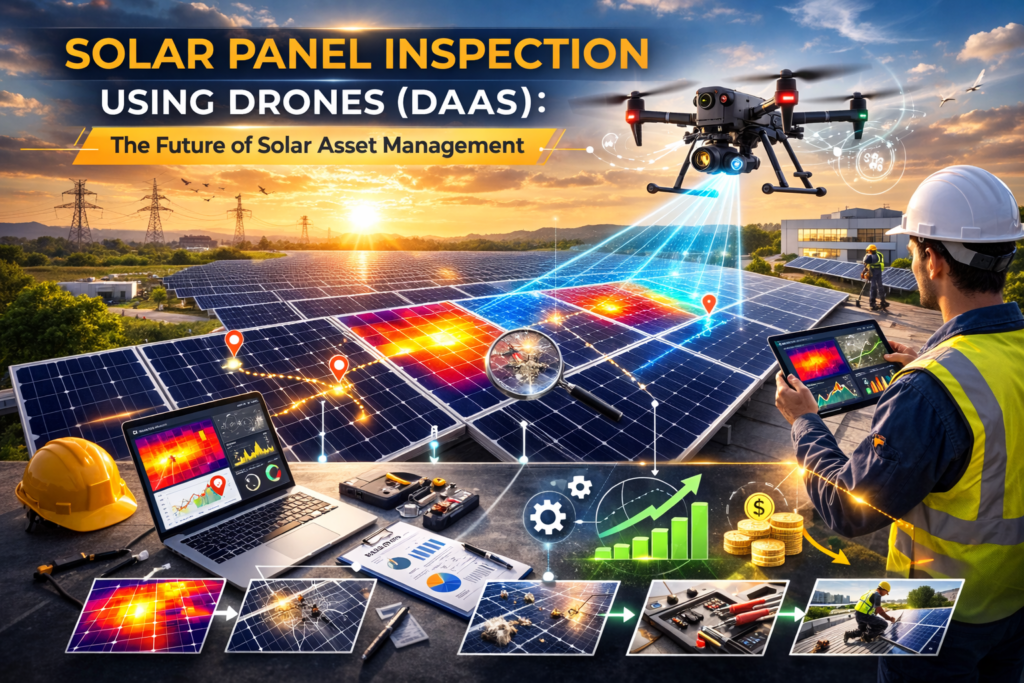
SOLAR PANEL INSPECTION USING DRONES (DAAS):
(The Future of Solar Asset Management)
With the rapid expansion of solar energy projects across rooftops, commercial buildings, and large-scale solar farms, solar panel inspection has become a critical component of asset management. Even small inefficiencies can lead to significant energy losses over time.
This is where Drone as a Service (DaaS) is revolutionizing the way solar panels are inspected—making the process faster, safer, more accurate, and highly scalable.
WHAT IS SOLAR PANEL INSPECTION AND WHY IS IT IMPORTANT?
Solar panel inspection involves evaluating panels to identify defects, performance issues, and environmental impacts that reduce energy output. Common issues include:
- Hotspots due to faulty cells
- Micro-cracks invisible to the naked eye
- Dust, bird droppings, or shading losses
- Loose connections and damaged modules
Regular inspection ensures maximum power generation, longer panel lifespan, and reduced maintenance costs.
TRADITIONAL METHOD OF SOLAR PANEL INSPECTION
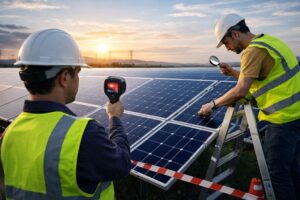
Traditional inspection methods rely heavily on manual labor and ground-based tools. Technicians visually inspect panels or use handheld thermal cameras.
Solar panels are designed to operate for decades, but their performance can degrade silently. Issues such as hotspots, micro-cracks, faulty connections, shading losses, and environmental damage often go unnoticed until energy output drops significantly.
Traditional inspection methods struggle to detect these problems early—leading to:
- Time-intensive for large solar plants
- Human error in detecting micro-level faults
- High operational cost due to manpower and equipment
- Safety risks when accessing rooftops or elevated structures
- Inconsistent data and non-standardized reporting
As solar installations grow and complexity, these methods struggle to keep pace. This is where drone-based inspection becomes a game changer.
DRONE-BASED SOLAR PANEL INSPECTION (DAAS)
Drone-based inspection uses advanced UAVs equipped with thermal and high-resolution RGB cameras to assess solar panels from the air. Under the DaaS model, organizations can access cutting-edge drone technology without investing in hardware, pilots, or software. Drone-Based Solar Panel Inspection is redefining how solar assets are monitored, maintained, and optimized—bringing intelligence, speed, and precision to clean energy operations.
How DaaS Works:
- Mission planning and automated flight paths
- Data capture using thermal and visual sensors
- AI-assisted data processing
- Detailed inspection reports with actionable insights
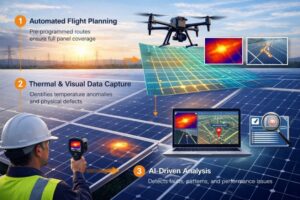
HOW DRONE-BASED INSPECTION WORKS
- Automated Flight Planning – Pre-programmed routes ensure full panel coverage
- Thermal & Visual Data Capture – Identifies temperature anomalies and physical defects
- AI-Driven Analysis – Detects faults, patterns, and performance issues
- Actionable Reporting – Easy-to-understand insights for maintenance teams
This structured approach ensures consistent, repeatable, and accurate inspections.
KEY BENEFITS OF DRONE-BASED SOLAR INSPECTION
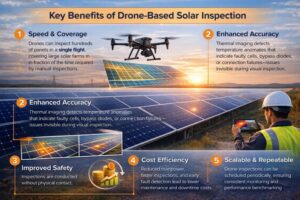
- Speed & Coverage – Drones can inspect hundreds of panels in a single flight, covering large solar farms in a fraction of the time required by manual inspections.
- Enhanced Accuracy – Thermal imaging detects temperature anomalies that indicate faulty cells, bypass diodes, or connection failures—issues invisible during visual inspection.
- Improved Safety – Inspections are conducted without physical contact, eliminating risks associated with climbing, scaffolding, or working at heights.
- Cost Efficiency – Reduced manpower, faster inspections, and early fault detection lead to lower maintenance and downtime costs.
- Scalable & Repeatable – Drone inspections can be scheduled periodically, ensuring consistent monitoring and performance benchmarking over time.
WHY EFFICIENCY MATTERS IN SOLAR PANEL INSPECTION
A single underperforming panel can affect the output of an entire string. Studies show that unnoticed defects can reduce plant efficiency by 5–20% over time.
Drone-based inspections enable:
- Early fault detection
- Predictive maintenance
- Optimized energy yield
- Extended asset life
- Improved ROI for solar projects
Efficiency directly impacts profitability, sustainability, and grid reliability.
TYPES OF OUTPUTS FROM DRONE-BASED SOLAR INSPECTION
Drone inspections deliver data-rich outputs that support fast decision-making
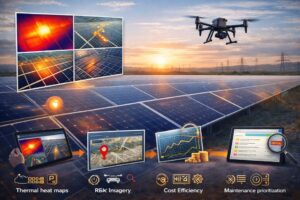
- Thermal heat maps identifying hotspots and abnormal patterns
- High-resolution RGB imagery for physical damage assessment
- Geotagged defect locations for easy maintenance tracking
- Automated inspection reports
- Historical performance comparisons
- Maintenance prioritization insights
These outputs integrate seamlessly with asset management and O&M workflows.
INDUSTRIES & APPLICATIONS USING DRONE SOLAR INSPECTION
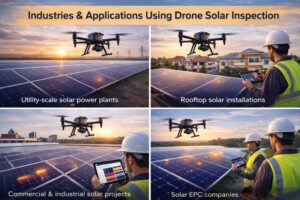
Drone-based solar inspection is widely adopted across:
- Utility-scale solar power plants
- Rooftop solar installations
- Commercial & industrial solar projects
- Solar EPC companies
- Solar O&M service providers
THE FUTURE OF SOLAR INSPECTION WITH DRONES
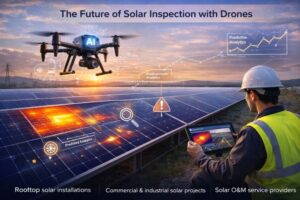
With advancements in AI, machine learning, and autonomous flight, drone inspections are evolving from fault detection to predictive performance intelligence. Future systems will forecast failures before they happen—making solar energy more reliable and resilient. As AI, automation, and sensor technologies evolve, drone inspections will become even more intelligent—enabling predictive analytics, fault classification, and autonomous decision support. DaaS ensures solar operators stay future-ready without heavy capital investment.
CONCLUSION
Drone as a Service (DaaS) is redefining solar panel inspection by combining speed, safety, accuracy, and efficiency. For solar asset owners and operators aiming to maximize performance and minimize losses, drone-based inspection is no longer an option—it’s a necessity.