
How Drones Are Emerging as the Next Game Changer in Intelligent Logistics
For centuries, the evolution of transportation has been driven by one fundamental objective: moving people and goods faster, farther and more efficiently.
Roads connected cities. Railways transformed inland freight movement. Ships enabled global trade between continents. Aircraft dramatically reduced the time required to travel across long distances.
Each mode of transportation solved a different limitation of the previous generation.
Today, logistics is entering another significant phase of transformation.
The next major shift may not be about replacing roads, railways, ships or aircraft. Instead, it will be about connecting these transportation systems more intelligently — with drones emerging as a powerful new layer in the logistics ecosystem.
Drones have the potential to change how goods move between warehouses, distribution centres, industrial facilities and hard-to-reach locations. More importantly, they can complement existing transportation infrastructure and create new possibilities for faster, more flexible and more responsive logistics.
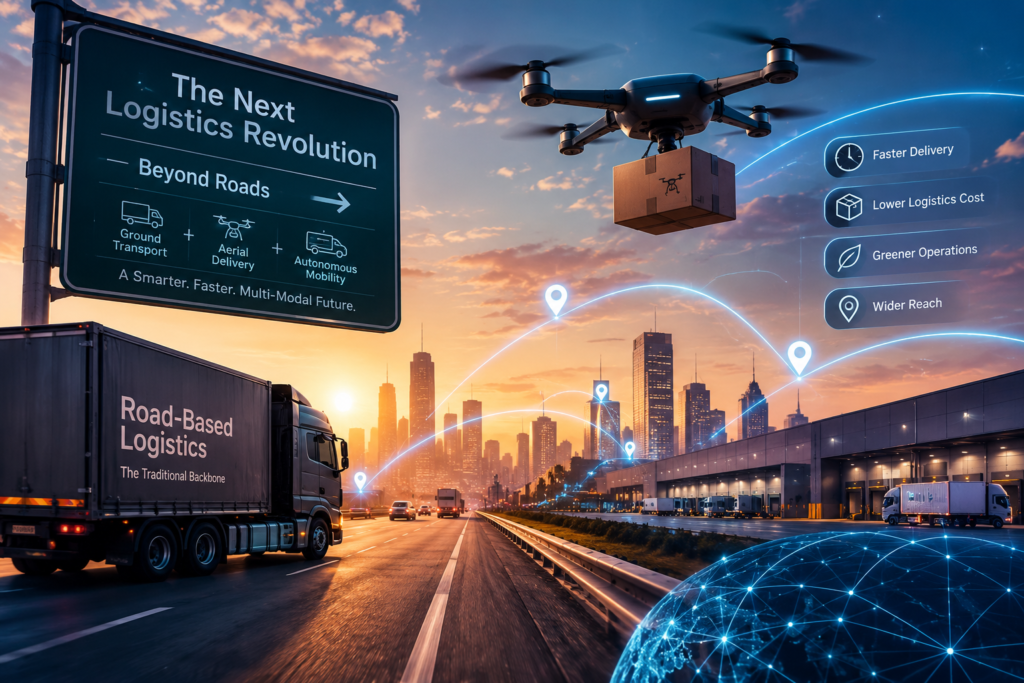
The Evolution of Logistics: Every Mode Has Changed the Way We Move
Modern logistics is not built around a single transportation system.
It is an interconnected network of different modes, each designed to solve a specific challenge.
Roads: The Backbone of last-mile connectivity – Almost !
Road transportation remains one of the most flexible components of the logistics ecosystem.
Trucks, vans and delivery vehicles can reach locations that are not directly connected by railways, airports or ports. This flexibility has made road transportation essential for both regional distribution and last-mile delivery.
However, road-based logistics also faces challenges.
Traffic congestion, fuel consumption, labour requirements, road conditions and increasing urban density can affect delivery speed and operating costs.
A shipment may travel hundreds of kilometres efficiently between major distribution centres, only to face significant delays during the final few kilometres.
This is one of the areas where new transportation technologies can create an additional layer of efficiency.
Railways: Moving Large Volumes Across Land
Railways transformed logistics by enabling the movement of large quantities of goods across long distances.
Freight trains can connect manufacturing centres, ports, warehouses and distribution hubs while supporting high-volume transportation.
Rail is particularly effective when cargo needs to travel predictable routes between established locations.
However, rail transportation depends on fixed infrastructure.
Goods must reach railway terminals, follow established routes and eventually be transferred to another transportation mode for final delivery.
This creates opportunities for complementary technologies that can connect railway infrastructure with locations beyond the railway network.
Ships: Connecting Global Supply Chains
If railways connected regions, ships connected the world.
Maritime transportation remains one of the most important components of international trade, allowing enormous volumes of goods to move between continents.
Ports serve as major logistics hubs where cargo is transferred between ships, trains, trucks and other transportation systems.
But maritime transportation also depends on port infrastructure and operates at a different speed compared with road or air transportation.
Once cargo reaches a port, it still needs to continue through another stage of the supply chain.
This creates a critical requirement:
How efficiently can cargo move from the major transportation hub to its next destination?
The answer increasingly lies in integrating multiple modes rather than depending on one system.
Aircraft: When Time Becomes the Priority
Aircraft introduced another major transformation in logistics: speed across long distances.
Air transportation is particularly valuable when shipments are urgent, high-value or time-sensitive.
Instead of spending days travelling through conventional transportation networks, cargo can cross large distances within a much shorter timeframe.
However, air logistics also depends on airports, cargo terminals, ground transportation and established aviation infrastructure.
A shipment arriving by aircraft does not automatically reach its final destination.
It still needs to move through the next stage of the logistics network.
This is where the next generation of transportation technology becomes particularly interesting.
Drones: The Next Game Changer in Logistics
Drones represent a fundamentally different approach to transportation.
They do not require roads.
They do not require railway tracks.
They do not depend on ships or ports.
And unlike conventional aircraft, drones can potentially operate closer to the point of delivery for suitable applications.
This creates a new dimension in logistics: direct, flexible aerial connectivity.
A drone can potentially connect two locations without requiring the shipment to travel through the entire conventional road network between them.
This does not mean drones will replace trucks, trains, ships or aircraft.
Instead, their greatest value may come from working alongside them.
The drone becomes another layer in the transportation ecosystem.
From Transportation Modes to One Connected Network
Imagine a shipment travelling internationally.
It may begin its journey on a ship, crossing thousands of kilometres.
At a port, it could move onto a train for long-distance inland transportation.
From a distribution centre, a truck could transport it to a regional facility.
For a time-sensitive final movement, a drone could potentially complete the journey where operationally and legally appropriate.
The logistics chain could look like:
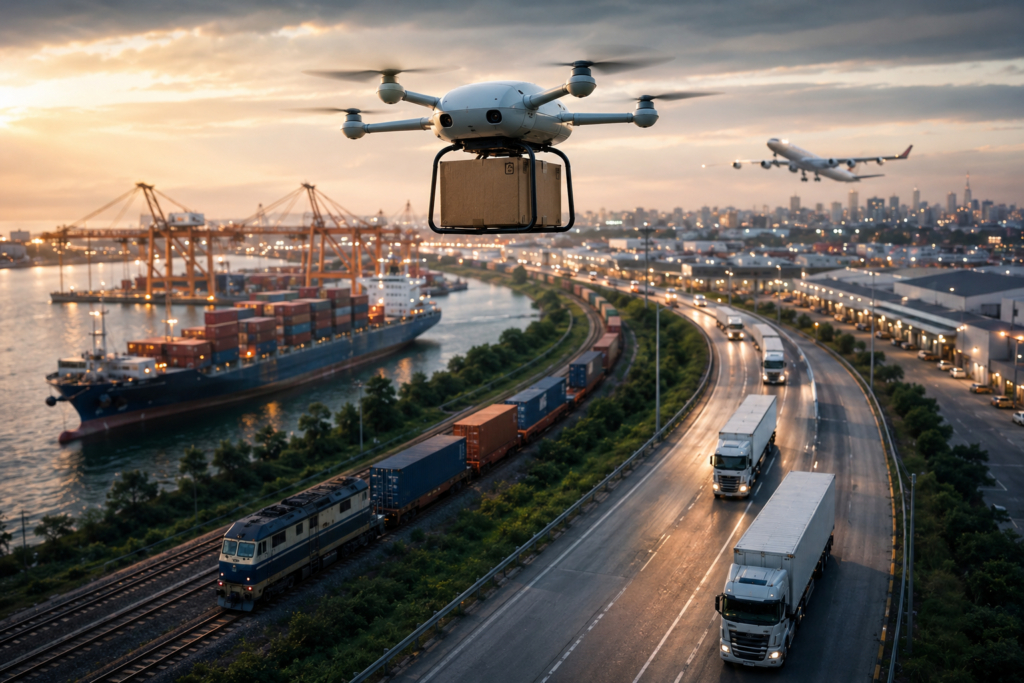
Ship → Port → Train → Distribution Centre → Truck → Drone → Destination
This is not about choosing between transportation technologies.
It is about using each technology where it creates the greatest value.
Ships provide scale.
Trains provide efficient long-distance inland movement.
Trucks provide flexibility.
Aircraft provide speed across long distances.
Drones provide a new layer of aerial flexibility.
Together, they can form a more connected logistics ecosystem.
Why Drones Could Transform the Middle Mile
Much of the discussion around logistics drones focuses on doorstep delivery.
But one of the most significant opportunities may actually lie in the middle mile.
The middle mile involves moving goods between facilities such as:
- Warehouses
- Distribution centres
- Manufacturing facilities
- Fulfilment hubs
- Industrial campuses
- Healthcare facilities
These movements can often follow predictable routes between known locations.
That makes them particularly interesting for drone-based logistics.
Consider two facilities located several kilometres apart.
A truck travelling between them may need to navigate traffic, intersections and road restrictions.
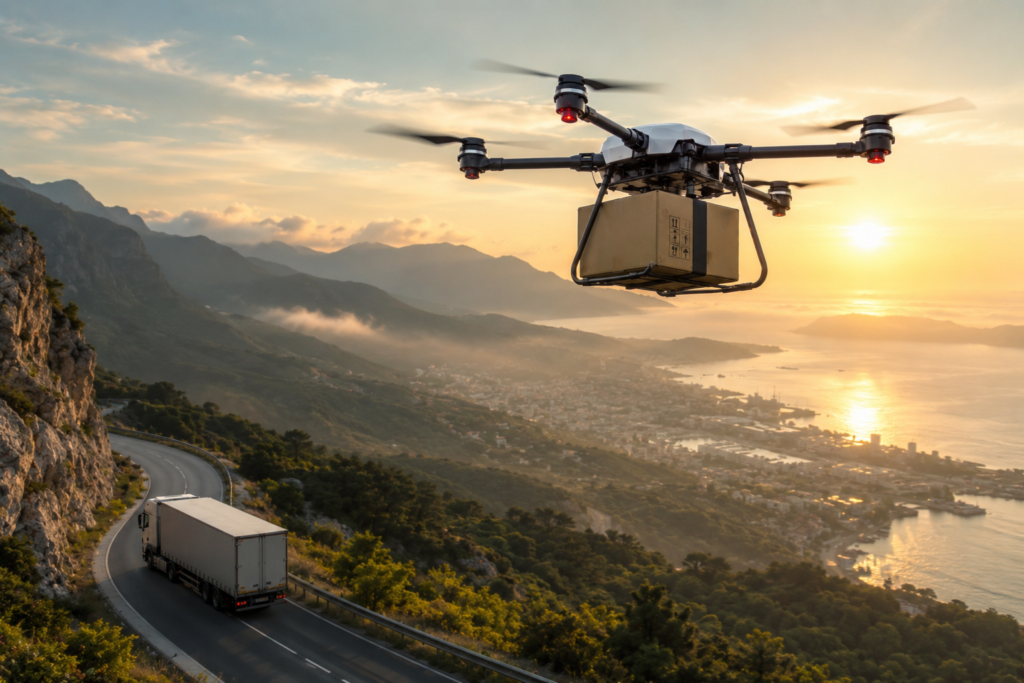
A drone, subject to payload, weather, airspace and regulatory requirements, can potentially establish a more direct aerial connection.
This could be valuable when time matters more than volume.
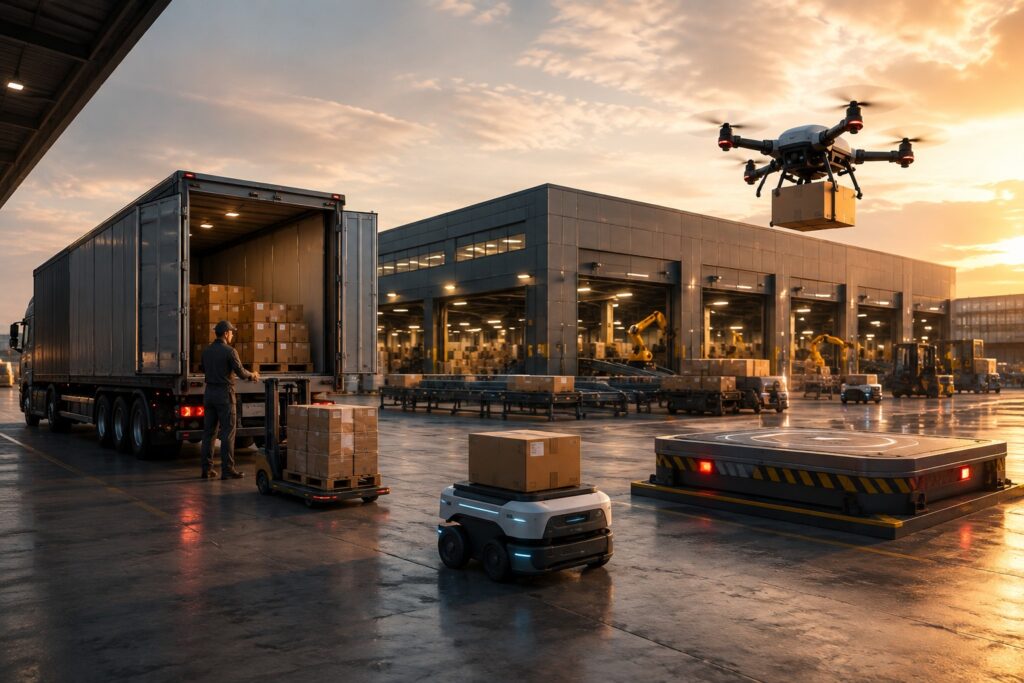
A drone does not need to replace the truck.
It can handle specific shipments that require faster movement while the truck continues carrying larger quantities of cargo.
Drones and the Last Mile
The final stage of delivery is often one of the most complex parts of the logistics chain.
A large shipment may have travelled efficiently across highways, railways, oceans or air routes before reaching a regional distribution centre.
The final few kilometres can still involve congestion, narrow roads, difficult terrain or significant delivery time.
This is where drones could provide a new option for suitable applications. 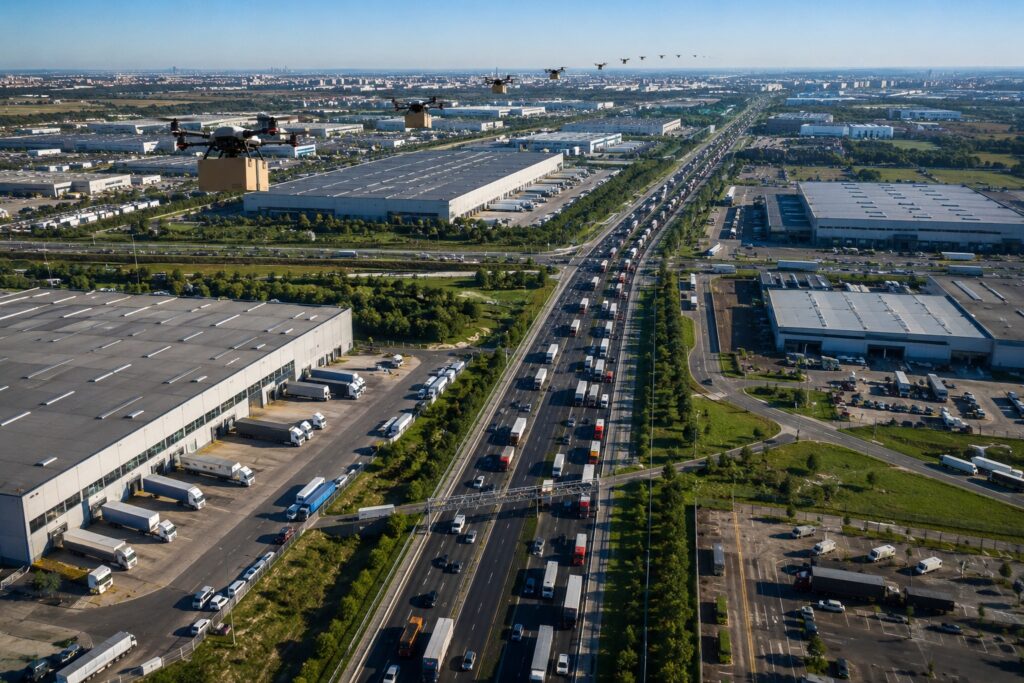
They could potentially support:
Urgent deliveries
Medical and pharmaceutical transportation
Industrial component movement
Remote-area logistics
Warehouse-to-warehouse movement
Emergency supply transportation
Time-sensitive shipments
The important point is that drones should not be viewed simply as flying delivery vehicles.
They can become connectors within a much larger logistics network.
The Real Opportunity: Drones Working With Existing Infrastructure
The biggest opportunity may not be drones operating independently.
It may be drones working together with existing transportation systems.
A logistics network could combine:
Ships + Trains + Trucks + Aircraft + Drones + Autonomous Ground Vehicles + AI
Each component performs a specific role.
A ship handles large international cargo.
A train handles high-volume inland movement.
A truck provides flexible ground transportation.
An aircraft handles long-distance urgent cargo.
A drone handles specific short-distance or hard-to-reach movements.
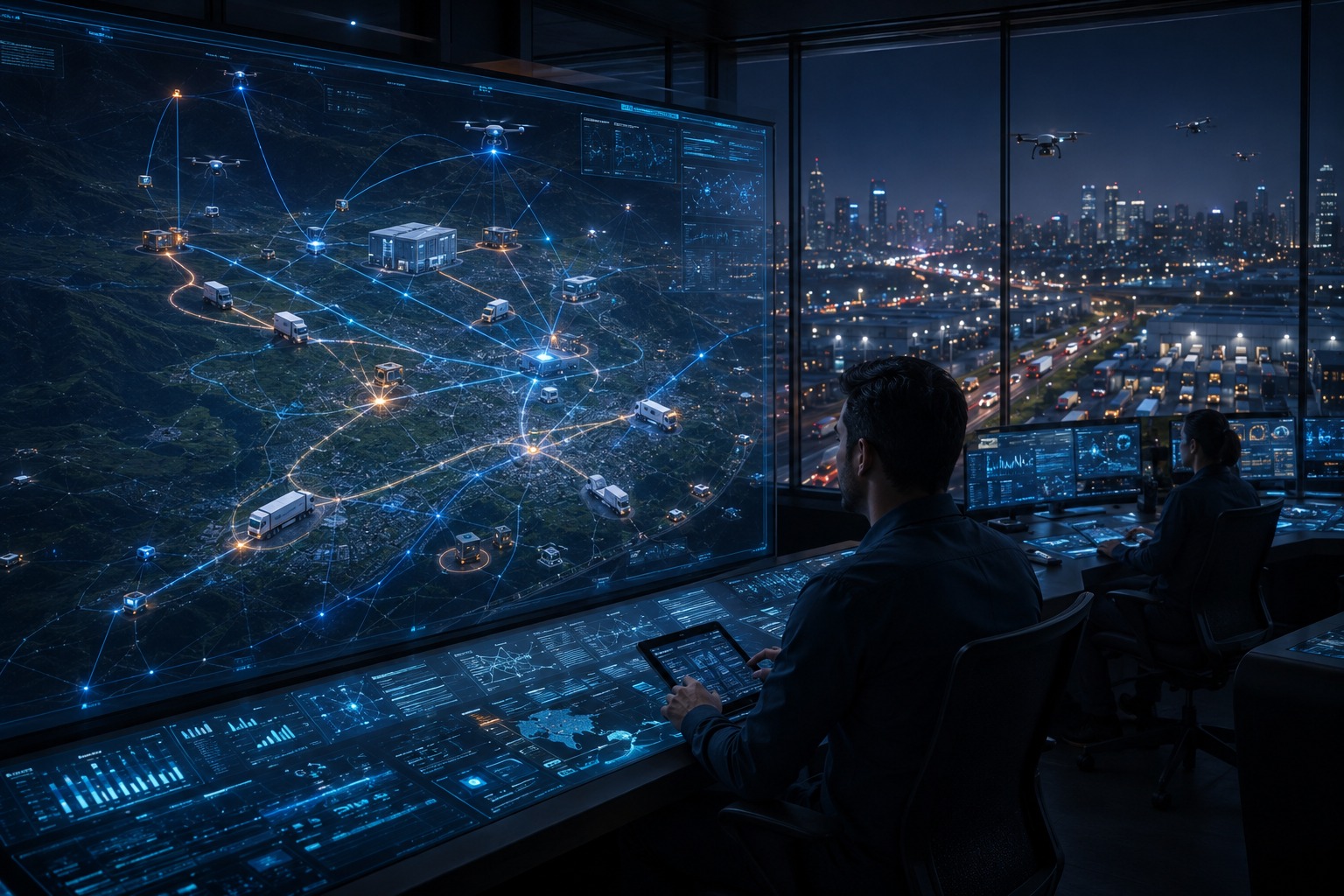
AI coordinates the entire system.
This creates a logistics model where transportation decisions are based not simply on what is available, but on what is most efficient for the shipment at that moment. 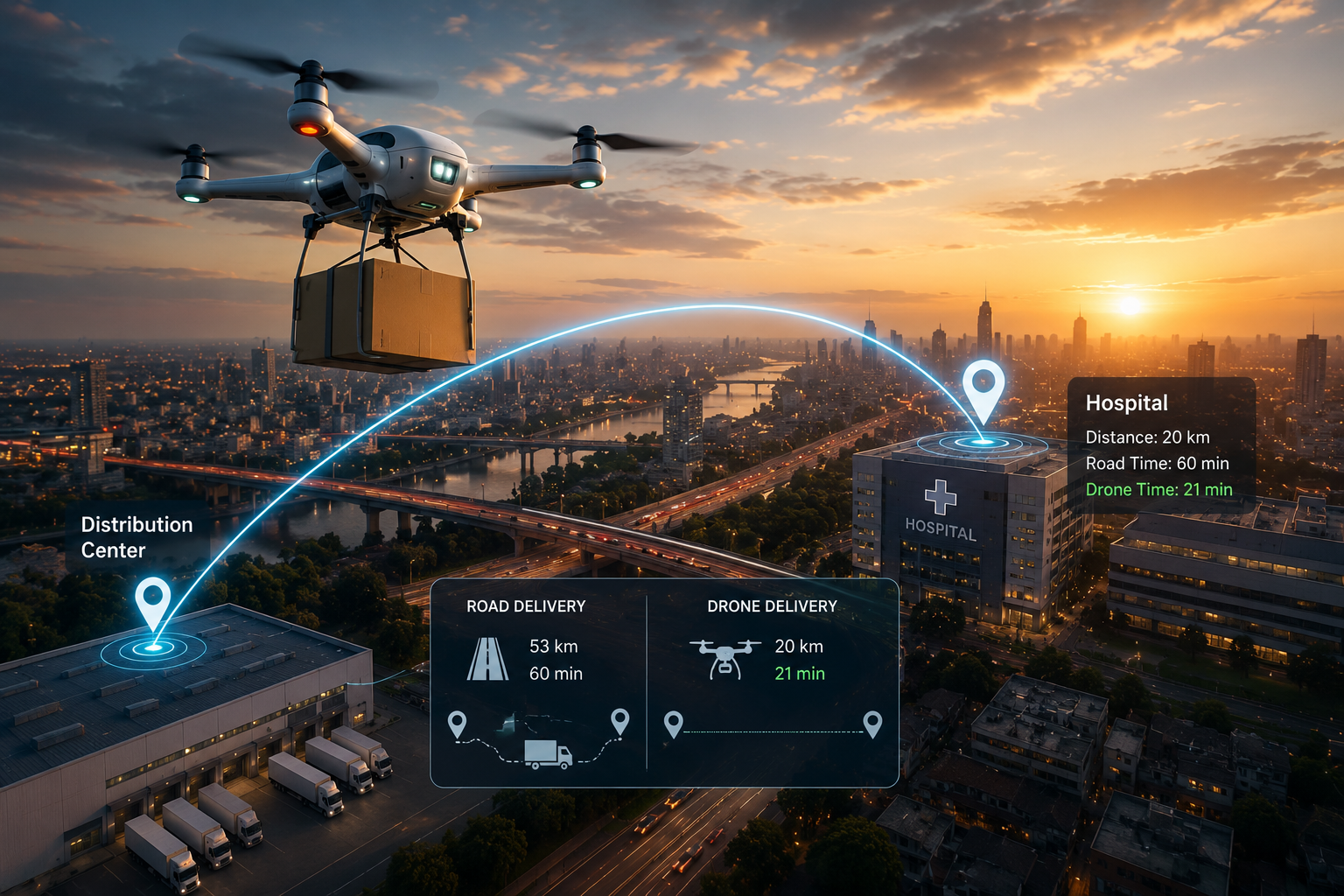
AI: The Intelligence Behind the Network
As transportation systems become increasingly connected, artificial intelligence can play an important role in coordinating them.
An intelligent logistics platform could potentially consider:
- Shipment priority
- Traffic conditions
- Weather
- Vehicle availability
- Drone battery levels
- Payload requirements
- Route restrictions
- Warehouse capacity
- Delivery deadlines
- Transportation costs
Based on these factors, the system could determine which transportation mode or combination of modes is most appropriate.
For example, a truck may carry hundreds of packages from a distribution centre.
At the next hub, the system identifies several urgent shipments.
Instead of assigning another truck to those shipments, an autonomous aerial system could potentially handle the urgent movement, subject to operational requirements.
The truck continues its planned route.
The drone handles the time-sensitive movement.
The AI system coordinates both.
This is intelligent logistics.
The Future Will Not Be “Drones vs. Trucks”
One of the biggest misconceptions about emerging transportation technologies is that one technology must replace another.
The future is more likely to be collaborative rather than competitive.
Trucks will continue to move large quantities of goods.
Trains will continue to connect major inland hubs.
Ships will continue to carry global cargo.
Aircraft will continue to provide high-speed transportation.
And drones can add another layer of flexibility to the network.
The future question is therefore not:
“Will drones replace trucks?”
It is:
“Where can drones work alongside trucks, trains, ships and aircraft to make logistics more efficient?”
That is where their real potential lies.
Building the Logistics Network of Tomorrow
The logistics network of the future could look very different from today’s transportation model.
A shipment could move through several modes during a single journey:
Manufacturing Unit → Truck → Railway Hub → Train → Port → Ship → Distribution Centre → Drone → Final Destination
Another shipment might follow:
Airport → Distribution Centre → Truck → Drone → Healthcare Facility
Or:
Warehouse → Autonomous Ground Vehicle → Drone → Production Line
The objective is not to make every shipment airborne.
The objective is to create a system capable of selecting the right transportation mode for the right shipment at the right time.
Challenges That Must Be Addressed
The potential of drone-enabled logistics is significant, but transformation will require more than technology alone.
Regulatory frameworks, airspace management, safety standards, weather conditions, battery technology, payload limitations and operational reliability must all be addressed.
Cybersecurity will also become increasingly important as logistics systems become digitally connected.
Most importantly, autonomous transportation must demonstrate that it can operate safely, consistently and reliably at scale.
The future will not be defined by whether a drone can successfully complete one delivery.
It will be defined by whether thousands of autonomous missions can be integrated into a wider transportation network without compromising safety or reliability.
From Transportation Systems to Intelligent Logistics
For generations, transportation innovation has focused on improving individual modes.
Better roads.
Faster trains.
Larger ships.
More efficient aircraft.
Smarter vehicles.
The next stage is different.
It is about making all of these systems work together.
And drones could become one of the most important new components of that ecosystem.
They introduce something traditional transportation infrastructure cannot easily provide: flexible aerial connectivity between locations.
They can potentially bridge gaps between warehouses, distribution centres, industrial facilities and hard-to-reach locations.
They can support urgent movements without requiring an entire road journey.
And when combined with AI and other autonomous technologies, they can become part of a much larger intelligent logistics network.
The Road Ahead
The future of logistics will not belong to roads alone.
It will not belong to railways alone.
It will not belong to ships or aircraft alone.
And it will not belong to drones alone.
The future will belong to the network that connects them.
Roads provide flexibility.
Railways provide scale across land.
Ships provide global connectivity.
Aircraft provide speed.
And drones introduce a new layer of direct, flexible aerial transportation.
The real transformation begins when these technologies stop operating as separate systems and start functioning as one intelligent logistics ecosystem.
The question for the next generation of logistics is no longer simply:
“How can we move goods faster?”
It is:
“How can we connect every mode of transportation to move the right shipment, through the right route, at the right time?”
Drones may be one of the most important answers to that question.
Because the next logistics revolution will not be about replacing the systems we already have.